
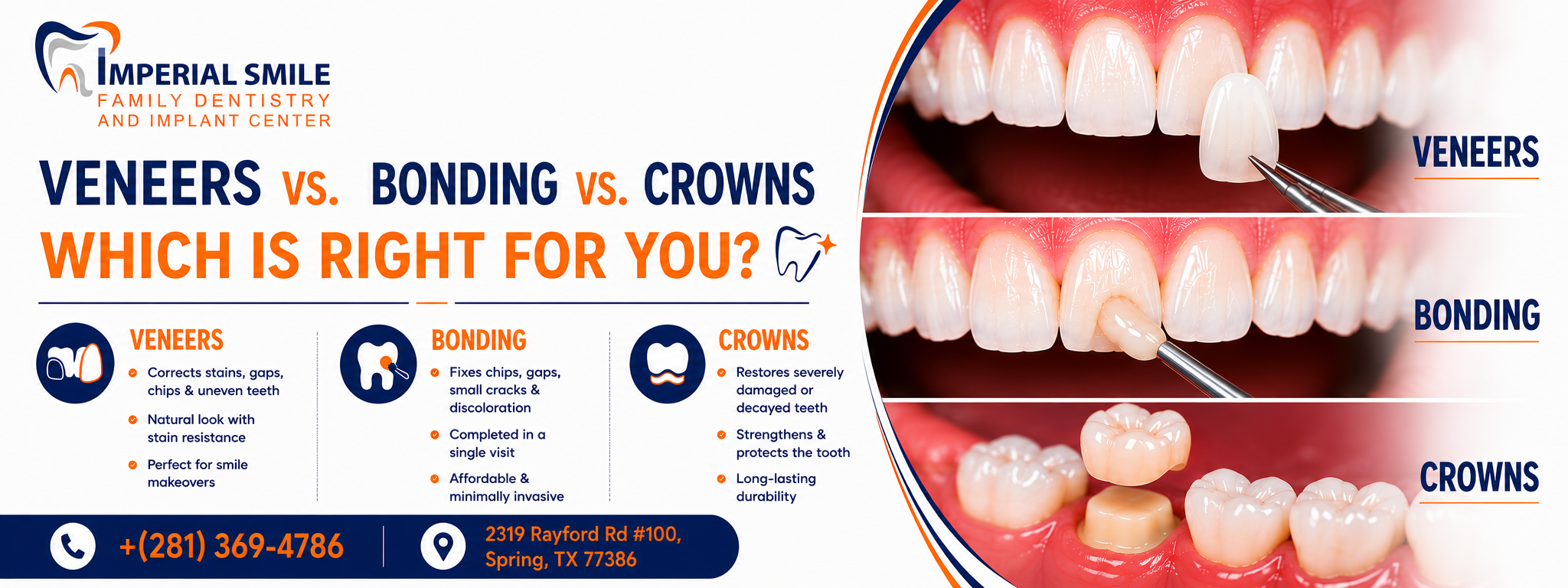
If you’ve been searching for a way to fix a chipped, stained, gapped, or worn-down tooth, you’ve probably come across three options again and again: veneers, dental bonding, and crowns. They all improve how your smile looks, but they work in very different ways, cost different amounts, and last for different lengths of time. Choosing the wrong one can mean spending more than you needed to—or ending up with a result that doesn’t hold up. This guide breaks down each option in plain language so you can walk into your consultation knowing exactly what questions to ask and what to expect.
Table of Contents
1. A Quick Overview
2. What Are Dental Veneers?
3. What Is Dental Bonding?
4. What Are Dental Crowns?
5. Side-by-Side Comparison
6. Cost: What You Can Expect to Pay
7. How Long Does Each Option Last?
8. Which One Is Right for You?
9. How to Decide With Confidence
10. Frequently Asked Questions
11. Book Your Free Smile Consultation
A Quick Overview
Before we dig into the details, here’s the simplest way to understand the three:
Bonding is the fastest and most affordable fix—a tooth-colored material is shaped directly onto your tooth in a single visit. Veneers are thin custom shells bonded to the front of your teeth, mostly used to transform the appearance of your smile. Crowns are full “caps” that cover the entire tooth and are used when a tooth is damaged, weak, or needs both protection and a cosmetic upgrade.
In short: bonding fixes small cosmetic issues, veneers redesign your smile, and crowns rebuild and protect damaged teeth. The right choice depends on how much of the tooth needs to be treated and whether the problem is purely cosmetic or also structural.
What Are Dental Veneers?
Dental veneers are thin, custom-made shells—usually porcelain or a high-quality composite—that are permanently bonded to the front surface of your teeth. Think of them as a facade that covers imperfections while keeping the natural tooth underneath largely intact.
Veneers are one of the most popular cosmetic dental treatments because they can correct several problems at once. They’re commonly used to cover deep stains that whitening can’t remove, close small gaps between teeth, reshape teeth that are chipped or uneven, and create a uniform, bright smile. Many people choose a set of six to eight veneers across their front teeth to achieve that “smile makeover” look.
Getting veneers usually takes two or three visits. During the first appointment, the dentist removes a very thin layer of enamel so the veneer sits flush and natural. Impressions are taken, and your custom veneers are crafted in a dental lab. At the next visit, they’re bonded permanently into place. Because a small amount of enamel is removed, porcelain veneers are considered a permanent treatment—the tooth will always need some form of covering afterward.
The main advantages of veneers are their natural, stain-resistant appearance and their ability to transform an entire smile. The trade-offs are the higher cost and the fact that the process is irreversible.
What Is Dental Bonding?
Dental bonding uses a tooth-colored composite resin—the same material used for tooth-colored fillings—that your dentist applies directly to the tooth, shapes by hand, and hardens with a special light. It’s essentially sculpting a repair right onto your existing tooth.
Bonding is the go-to option for minor cosmetic touch-ups. It works beautifully for small chips, minor cracks, tiny gaps, slightly discolored teeth, or teeth that are a little too short or oddly shaped. Because the dentist does everything in the chair, most bonding can be completed in a single visit lasting 30 to 60 minutes per tooth.
The downside is durability. Composite resin isn’t as strong or as stain-resistant as porcelain, so bonded teeth can chip or discolor over time, especially with coffee, tea, red wine, or smoking. Bonding is an excellent, budget-friendly choice for small fixes, but it’s not designed for major smile transformations or for teeth under heavy biting pressure.
What Are Dental Crowns?
A dental crown is a custom-made cap that covers the entire visible portion of a tooth, restoring its shape, size, strength, and appearance. Unlike veneers, which only cover the front surface, a crown wraps around the whole tooth.
Crowns are used when a tooth is more than just cosmetically flawed—when it’s cracked, badly decayed, severely worn, or weakened after a root canal or a large filling. In those cases, a veneer or bonding wouldn’t provide enough protection. Crowns are also used on top of dental implants to replace missing teeth. So while crowns absolutely improve appearance, their main job is to protect and restore function.
Getting a crown typically involves reshaping the tooth to make room for the cap, taking impressions, and placing the crown at a follow-up visit (many offices now offer same-day crowns using digital technology). Crowns can be made from porcelain, ceramic, porcelain-fused-to-metal, or zirconia, with the material chosen based on the tooth’s location and how much biting force it handles.
The strength of crowns is exactly that—strength and longevity. They can withstand normal chewing for many years and restore a tooth that might otherwise need to be extracted. The trade-off is that placing a crown requires removing more tooth structure than a veneer or bonding, and the cost is generally higher.
Cost: What You Can Expect to Pay
Cost is often the deciding factor, so it’s worth understanding the general ranges. Keep in mind that actual prices vary based on your location, the materials chosen, the dentist’s experience, and how many teeth you’re treating.
Dental bonding is the most affordable option, typically costing somewhere between $150 and $600 per tooth. Because it’s usually a cosmetic procedure, insurance often won’t cover it — but if bonding is being used to repair a cavity or a fractured tooth, part of it may be covered.
Veneers sit in the middle-to-higher range, usually between $900 and $2,500 per tooth for porcelain, with composite veneers costing less. Since veneers are almost always cosmetic, insurance rarely covers them, though many practices offer financing or membership plans to spread out the cost.
Crowns generally range from about $800 to $2,000 per tooth depending on the material. Because crowns are frequently medically necessary — protecting a cracked or root-canaled tooth — dental insurance often covers a meaningful portion of the cost.
If budget is a concern, don’t rule anything out until you’ve talked to your dentist. Many offices, including ours, offer free consultations, flexible financing, and periodic free-care events that make treatment far more accessible than most people expect.
How Long Does Each Option Last?
Longevity is closely tied to cost — you generally get what you pay for, and how well you care for your teeth makes a big difference.
Bonding typically lasts anywhere from three to eight years before it needs touching up or replacing, because the composite material is more prone to chipping and staining. Veneers, especially porcelain ones, commonly last ten to twenty years or more with good care. Crowns are similarly long-lasting, often serving well for ten to twenty years, and sometimes longer.
In all three cases, the same habits protect your investment: brushing twice a day, flossing, avoiding using your teeth as tools, wearing a night guard if you grind, and keeping up with regular dental checkups.
Which One Is Right for You?
The best way to narrow it down is to match the treatment to your actual problem.
If you have a single small chip, a minor gap, or a slightly discolored tooth and you want an affordable, fast fix, dental bonding is usually the smartest starting point. It’s conservative, reversible, and easy on the budget.
If your teeth are structurally healthy but you’re unhappy with the overall look of your smile—stains that won’t lift, uneven shapes, small gaps across several front teeth — and you want a dramatic, long-lasting transformation, veneers are likely your best fit.
If a tooth is cracked, heavily decayed, worn down, or weakened after a root canal, a crown is almost always the right answer, because it restores strength and protects the tooth from further damage while still looking natural.
Many people actually benefit from a combination—for example, crowns on damaged back teeth and veneers or bonding on the front teeth for cosmetic polish. That’s why a professional evaluation matters so much: the right plan is often a mix rather than a single choice.
How to Decide With Confidence
You don’t have to figure this out on your own—and honestly, you shouldn’t, because the right choice depends on the health of each individual tooth, your bite, your goals, and your budget. A dentist can examine your teeth, take X-rays if needed, and show you exactly what each option would look like for your specific situation.
The best next step is a consultation where you can ask questions, see examples, and get a clear treatment plan with real numbers. Come prepared with what bothers you most about your smile and what your budget looks like, and a good dentist will walk you through the trade-offs honestly.
Frequently Asked Questions
Are veneers better than bonding?
Neither is universally “better” — they serve different purposes. Veneers last longer, resist stains, and are ideal for transforming multiple teeth, but they cost more and are permanent. Bonding is cheaper, faster, and often reversible, making it great for small fixes. The better option depends on the size of the problem and your goals.
Do veneers, bonding, or crowns ruin your natural teeth?
Bonding usually requires little to no enamel removal, so it’s the most conservative. Veneers and crowns both require removing some tooth structure, which makes them permanent—but when done properly, they protect and preserve the tooth for years rather than harming it.
Which option looks the most natural?
All three can look very natural in skilled hands. Porcelain veneers and ceramic crowns tend to look the most lifelike because the material mimics the way real enamel reflects light and resists staining. Bonding looks great initially but may dull or discolor over time.
Is dental bonding or a crown better for a chipped tooth?
It depends on the size of the chip. A small chip is usually best treated with bonding. which is quick and affordable. A large chip, or a chip on a tooth that’s cracked or weak, is better protected by a crown that covers and reinforces the whole tooth.
Does insurance cover any of these treatments?
Crowns are frequently covered, at least partially, when they’re medically necessary. Veneers and cosmetic bonding are usually considered elective and are rarely covered. However, many practices offer financing, membership plans, or free-care events to help make treatment affordable.
How do I know which one I need?
The only reliable way is a professional exam. A dentist can assess the health and strength of each tooth, discuss your cosmetic goals, and recommend the option—or combination of options—that gives you the best result for your budget.
Book Your Free Smile Consultation